Friday, June 12, 2015
Papers on Documentation and Archiving of Virtual Creations by Dennis Moser
Dennis Moser is a rare book librarian and archivist at the Rasmuson Library, University of Alaska, Fairbanks. He also is a musician who has performed live concerts in the Second Life virtual world for many years as avatar Aldomanutio Abruzzo. His experience with virtual reality and its transient nature informs his academic writing. Two recent papers of his that you now can download from academia.edu explore the issues and history related to documenting and archiving new media works. More of his papers on archival preservation of virtual material are available for download here.


Sunday, February 5, 2012
Bronzeville Etudes & Riffs Moves from Second Life® to Unity3 Platform
In a major expansion of concept, artist Philip Mallory Jones has moved the development of Bronzeville Etudes &: Riffs onto the Unity 3 game development platform, which will make it available on web browsers and on portable devices that use the iOS and Android operating syatems. He now calls this work an immersive graphic novel. Open it and you step into the Chicago South Side and experience life there as a Black American from the turn of the 20th century to the 1950s.
See the Sept. 30 2011 post for background, or visit The ArtWorld Market Report website.
See the Sept. 30 2011 post for background, or visit The ArtWorld Market Report website.
Friday, September 30, 2011
BRONZEVILLE Etudes & Riffs
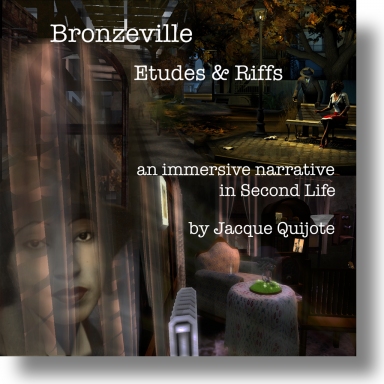
Jacque Quijote is the avatar of artist Philip Mallory Jones in the Second Life® virtual world. We selected the work of Jacque Quijote "In the Sweet Bye & Bye" as a "Pick of the Week" in May, 2007, and featured this work in our 2007 print monograph, The Second Life® Art World.
His current work-in-progress advances the development of narrative immersive space, and is a paradigm of the artistic exploration of virtual technology. Click on the image to the right and read all about it. Then immerse yourself in it.
Mr. Jones has also written an extensive illustrated essay on his development of immersive technology art, beginning with his first Heathkit quartz crystal radio receiver as a youth in the 1950s. It is required reading for anyone interested in the creative process.
The essay, "First Life to Second Life: Notes on the Design and Development of a Synthetic World Installation, In The Sweet Bye & Bye: An Immersive Memoir:" can be read online. Philip Mallory Jones was Artist in Residence at Ohio University's Aesthetic Technologies Lab when he created In The Sweet Bye & Bye.
In April, 2011 he created a series of Mind Maps that visualize his current research and development for Bronzeville Etudes & Riffs. There are two kinds, one charts the narrative threads and navigation paths, the other is an accurate street map (in four parts) 1925-1955.
In April, 2011 he created a series of Mind Maps that visualize his current research and development for Bronzeville Etudes & Riffs. There are two kinds, one charts the narrative threads and navigation paths, the other is an accurate street map (in four parts) 1925-1955.
Saturday, February 13, 2010
First Life to Second Life
Review:
First Life to Second Life
by Philip Mallory Jones
(aka SL Jacque Quijote)
First Life to Second Life
by Philip Mallory Jones
(aka SL Jacque Quijote)
We selected the work of Jacque Quijote "In the Sweet Bye & Bye" as a "Pick of the Week" in May, 2007, and featured this work in our 2007 print monograph, The Second Life® Art World. Now Mr. Jones has written an extensive illustrated essay on his development of immersive technology art, beginning with his first Heathkit quartz crystal radio receiver as a youth in the 1950s. It is required reading for anyone interested in the creative process.
The essay, "First Life to Second Life: Notes on the Design and Development of a Synthetic World Installation, In The Sweet Bye & Bye: An Immersive Memoir:" can be read online at the website of Ohio University's Aesthetic Technologies Lab, where Philip Mallory Jones is Artist in Residence.
Friday, October 9, 2009
THE IMAGINE CHALLENGE

Competition entries on view at UWA
Jayjay Zifanwe, quadrapop Lane, and the University of Western Australia (UWA) team welcome visitors to the announcement of the September Monthly Winners of the UWA 3D Art & Design Challenge (IMAGINE & FLAGSHIP competitions). This will be held at 5am SLT, October 11, 2009 at the Art & Design Platform on WASP Land. If that's out of your time zone or you are reading this at a later date, keep reading!
The challenges will run monthly through August 2010. Read on for how to enter the next challenge, or click here to teleport to their Second Life location.
There are 2 competitions running simultaneously, the IMAGINE challenge and the FLAGSHIP challenge. There are monthly prizes available separately for both, and the top 2 each month will go into the pool for the Grand Prize (which will have an expanded judging panel). You can enter as many times as you like or for any month that you choose. For the Imagine challenge there will also be a monthly prize for best non-scripted entry
THE IMAGINE CHALLENGE
In describing virtual worlds, it is often said, 'we are truly limited by only the imagination', and and that is the theme of this art challenge. The limits are the imagination. Create something that will take our breath away. Any form, any shape, any influence, any medium. Of this world, or the next! (size 100 prim)
Prizes will be offered to winners & runners-up every month till the 31st of August 2010. Grand Prize to be awarded at the end. Monthly winners & runners up to be displayed in the Second Life installation of the Lawrence Wilson Art Gallery, on the grounds of the University of Western Australia (UWA - this island). All winners COULD also be part of a real life (RL) exhibition of digital interactive art at the University of Western Australia in 2010.
Design a building that captures the essence of creative engagement, which could possibly be built.The University of Western Australia plans to build such a building in real life. It is to be called FUTURElab. FUTURElab will provide insights into the world we are shaping by putting a microscope on the research undertaken across the University. It will provide a showcase for the work of SymbioticA for the architects and designers from UWA’s Faculty of Architecture, Landscape and Visual Arts who are exploring new possibilities for themselves and their communities and for those working with new and emerging technologies to shape our future. FUTURElab will incorporate a black box performance/screening environment, a science/art gallery and teaching and presentation space for a range of activities across campus. It will also provide a hub for the Creative Industries Innovation Centre (CIIC), of which UWA is a partner.
IMAGINE PRIZES
Monthly Prize 3,500L (1st) 500L (2nd)
Monthly Prize 3,500L (1st) 500L (2nd)
500L (Best non-Scripted entry)
Grand Prize 50,000L (1st) 10,000 (2nd)
THE FLAGSHIP CHALLENGE
Design the UWA Cultural Precinct Flagship Building
Design the UWA Cultural Precinct Flagship Building
Design a building that captures the essence of creative engagement, which could possibly be built.The University of Western Australia plans to build such a building in real life. It is to be called FUTURElab. FUTURElab will provide insights into the world we are shaping by putting a microscope on the research undertaken across the University. It will provide a showcase for the work of SymbioticA for the architects and designers from UWA’s Faculty of Architecture, Landscape and Visual Arts who are exploring new possibilities for themselves and their communities and for those working with new and emerging technologies to shape our future. FUTURElab will incorporate a black box performance/screening environment, a science/art gallery and teaching and presentation space for a range of activities across campus. It will also provide a hub for the Creative Industries Innovation Centre (CIIC), of which UWA is a partner.
Prizes offered to winners & runners-up every month till the 31st of August 2010. Grand Prize to be awarded at the end. The winning entry, will be given a permanent location on the grounds of the SL grounds of the University of Western Australia. The winning entry may be considered as a possible baseline design for one of the actual buildings that will be built at the RL location of the expanding Cultural Precinct of the University of Western Australia. The creator of the building will be contacted to consult on how to turn the Second Life design, into reality.
FLAGSHIP PRIZES
Monthly Prize 3,500L (1st) 500L (2nd)
Grand Prize 50,000L (1st) 10,000 (2nd)
Monthly Prize 3,500L (1st) 500L (2nd)
Grand Prize 50,000L (1st) 10,000 (2nd)
THE SECOND LIFE® IMAGINE FESTIVAL
October 9—15, 2009
Imagine Festival features many programs
UTSA Art Space Full-Sim Exhibition
click here for a schedule of events

Gamma Infinity created this activated entrance sculpture
Imagine Festival features many programs
UTSA Art Space Full-Sim Exhibition
click here for a schedule of events
Gamma Infinity created this activated entrance sculpture
The Imagine Festival includes an ambitious program of music, poetry, drama, and interactive experiences. It launches at Four Bridges—a new Imagine build by AuraKyo Insoo. It spans 10 sims, and coincides with the opening of the Imagine Peace Tower commissioned by Yoko Ono. The Tower will be unveiled and officially opened on Imagine Peace Island at 3:30pm SLT, Friday 9 October.
Also featured in this year's festival is a major build offered by UTSA (University of Texas at San Antonio). The UTSA's newly developed Art Space consists of a full-sim exploration of the seasons that incorporates the artistic impressions of a diverse group representing of artists. Each of these artists have made contributions to one or more of the seasons that speak to the future of weather in a unique way.
Other creative events to be found in the Festival are; Africa Live, Tales and Legends of Africa, CHAMBER of our HEART, Undersea Mermaid Poetry, Pentagon of Peace by Netroots Nation, and CARP (Cybernetic Arts Research Project).
According to their Press Release, The Imagine Network works for a better world, with a focus on human rights, as well as social and environmental justice for all. They aim to identify the root causes of the larger toxic global problems facing us in order to help find solutions, and to help people act together in cooperation toward that goal.
ArtWorld Market was given an advance tour of the UTSA installation on October 8 by Gary Kohime, IMAGINE@UTSA Director. There are works by established SL artists like Alizarin Goldflake and Artistide Despres, as well as emerging artists.
Also featured in this year's festival is a major build offered by UTSA (University of Texas at San Antonio). The UTSA's newly developed Art Space consists of a full-sim exploration of the seasons that incorporates the artistic impressions of a diverse group representing of artists. Each of these artists have made contributions to one or more of the seasons that speak to the future of weather in a unique way.
Other creative events to be found in the Festival are; Africa Live, Tales and Legends of Africa, CHAMBER of our HEART, Undersea Mermaid Poetry, Pentagon of Peace by Netroots Nation, and CARP (Cybernetic Arts Research Project).
According to their Press Release, The Imagine Network works for a better world, with a focus on human rights, as well as social and environmental justice for all. They aim to identify the root causes of the larger toxic global problems facing us in order to help find solutions, and to help people act together in cooperation toward that goal.
ArtWorld Market was given an advance tour of the UTSA installation on October 8 by Gary Kohime, IMAGINE@UTSA Director. There are works by established SL artists like Alizarin Goldflake and Artistide Despres, as well as emerging artists.

Seasonal art from Alizarin Goldflake
a view from inside her activated sculpture "Immersive Art_Halloween Haloes."

Sun's Birth" by Ub Yifu reminds us of the influence of early Starax sculptures.
Saturday, August 8, 2009
Playing from the Grave
5th Annual Colloquium on the Law of Futuristic Persons
The above-titled conference will be held in the Second Life® virtual world on December 10, 2009. It is organized by Terasem Movement, Inc. a not-for-profit organization that also publishes two Terasem Journals. The focus is on the rights of people who will be revived from biostasis—cryogenic preservation of legally (but not irreversibly) dead or near-dead people waiting for a cure, and cyberstasis—people whose consciousness is preserved digitally.
Does immersion in virtual reality involve similar legal issues? As the technology of personality archiving gets closer, VR citizens may opt to transition from DNA to silicon existence. The legal/ethical issues they are dealing with might make you think of Arthur C. Clarke or Isaac Asimov, but relevance is relative, in light of current concerns about AI and FMRI.
For example, one of the papers in the current issue of The Journal of Personal Cyberconsciousness is "Pros and Cons of Corporate Personhood for Transbemans" by Dr. Martine Rothblatt: "Dr. Rothblatt imposes the legal notions of corporate personhood upon transbemans or futuristic persons, specifically those who transition from flesh-ware to software, and may lack the traditional DNA based biological substrate."
There are over 20 issues of the above journal and their Journal of Geoethical Nanotechnology, with articles by prominent scientists, lawyers, psychologists, etc. in the Terasem online archive.
If you would like to submit a paper for the conference, or have further interest in this, get in touch with the editor of the Journals, Loraine J. Rhodes, either through the Contact link on their website or by IM in SL to Lori Darling.
Saturday, June 27, 2009
Maryva Mayo, Red Randt, Filthy Fluno and Feathers Boa at the Aho Museum
on The New Media Consortium Campus

Tayzia Abattoir, the Aho's curator, has again put together an exceptional exhibition combining established and emerging artists. It is Red Randt's first exhibition, and Filthy Fluno is the best known artist to emerge from the virtual world of Second Life to the "real" world, having had a six page article in The New York Times Magazine.
Waning
by Feathers Boa

In this case the proximity dissolves the woman's image, revealing the remainder of the text. It is a thoughtful and satisfying series. The artist has mastered the technical aspects of this medium and is applying a maturing sense of narrative sequential art and metaphor.
We have seen many artists use interactivity in gimmicky ways, or for its own sake, but in this case it is integral to the work.
This is the first time we have seen Italian artist Maryva Mayo's work, abstract images that are in motion. They are beautiful, but transcend the decorative with a confident sense of spatial depth and interaction of line, form, and transformation.
The influence of abstract expressionism and gesture painting is strong. "La rinascita," for example, evokes Mark Tobey and Rothko.
La rinascita - La renaissance-The rebirth G
New introductions of energy
by Maryva Mayo

The images on this page are just snapshots of a moment in each of the works--you have to stay and watch them "perform" to fully experience them.
Cosmic explosion
by Maryva Mayo

You also can use your camera to go inside these works and experience them as a full screen light show, as in this internal view of "Dream / Sogni."

Dream / Sogni by Maryva Mayo
The 26 works by Red Randt exhibit a wide variety of techniques, primarily sculptural. Some are stationary, while others are active. "The Wobbly Building" (right) is a flexi prim work that collapses and "inflates."Several of this artist's works are "hommage,"--tributes to artists including Magritte (a pipe that says "This is not a Magritte") and this "soft" building, which is a tribute to Claes Oldenburg.
The Wobbly Building
by Red Randt

These works are well done and fun, with a sense of pun and wordplay. The artist's extensive notes, for example, are dispensed by clicking on this sculpture of notes:
Notes
by Red Randt

Filthy Fluno continues his exploration of Surrealism, Expressionism and Symbolism with mixed reality works that involve images inspired by his virtual world experiences, executed in real world pastel or oil paint, photographed, digitally manipulated, and imported into Second Life.
In some cases the image is duplicated and flipped, creating a bug-eyed creature from which the multilayered content emerges. The current work reminds us of Alfonso Ossorio.
New Glasses Mirrored #1/5 Aho Edition
by Filthy Fluno
Tuesday, June 2, 2009
Changes are coming to the Report
If you haven't been to The ArtWorld Market Report website recently take a look at the new format. The archived features now headline the site, making it easier for people who are new to the SL art world to see what has been going on the last few years.
In the past we have directed much of the editorial content of the Report toward Second Life residents, and the language often reflected the assumption that our readers were familiar with and had first-hand experience of life in a virtual world. In the future we will be directing content toward the real-world resident who may have limited or no knowledge of virtual life, presenting the work of artists who use the virtual world as a creative medium.
The goal of this shift is to reach out to the "real" art world with reviews and critical essays that establish virtual art as a recognized field in "New Media" that will enable artists to secure funding for virtual art projects.
If you have theoretical, practical, or critical comments or articles you would like to contribute to this effort, please get in touch with ArtWorld Market.
In the past we have directed much of the editorial content of the Report toward Second Life residents, and the language often reflected the assumption that our readers were familiar with and had first-hand experience of life in a virtual world. In the future we will be directing content toward the real-world resident who may have limited or no knowledge of virtual life, presenting the work of artists who use the virtual world as a creative medium.
The goal of this shift is to reach out to the "real" art world with reviews and critical essays that establish virtual art as a recognized field in "New Media" that will enable artists to secure funding for virtual art projects.
If you have theoretical, practical, or critical comments or articles you would like to contribute to this effort, please get in touch with ArtWorld Market.
Saturday, March 7, 2009
FILTHY TIMES
Filthy Fluno is the subject of a six page feature article in The New York Times Magazine
We have been writing about Filthy since December, 2006, before he started the island art colony of Artropolis in the Second Life® virtual world. The New York Times has now discovered him, and delves into the question of whether building a virtual career as an artist can create a real world career. Well-duh...it got him six pages in the NYT Magazine of Sunday March 8, 2009. The article quotes ArtWorld Market, in his real world identity as Richard Minsky. You can read the article online if you can't get the paper edition. You also can scroll down and read our articles about Filthy.
The NYT article also includes some good quotes from Dancoyote about virtual art, and below is our review of his current ZeroG SkyDancers performance. The journalist also visited Brooklyn is Watching, and interviewed researchers who have discovered that obese people who have thin avatars are more likely to lose weight.
Tuesday, February 24, 2009
Filthy Pictures Bridge Two Worlds
Filthy Fluno is a master of the real/virtual interface. His works use traditional media, like oil paint and pastels, to create abstract representations of virtual places and characters. He then markets the images in the Second Life® world as virtual limited editions that com with a real-world giclée print, and also sells the original paintings and drawings. He has had several international exhibitions that came about through virtual contacts.

Read about his real/virtual CounterpART Gallery.
Tuesday, February 17, 2009
Let Love Live
Must See This Month:

The New Media Consortium
hosts
DanCoyote's
Zero-G SkyDancers
in
Let Love Live (L3)
Through March, 2009
Saturday, February 14, 2009
Digital Reproductions
[reprinted from the old blog site 4/16/07, with comments]
Karen Schreiner makes a point that requires a new thread:
The 3D metal prints of Bathsheba are created from original code. So are the 3D SL objects, like Bathsheba Dorn's RhombdO. We have not been calling them prints, but perhaps we should.
We can tell an original print on paper because it's signed by the artist. The signature signifies approval of that copy as authentic. That notion requires more thought, and a lot of thought has been done on it. I suggest reading the essays and their commentaries on Authenticity in Art by Denis Dutton, From Original to Copy and Back Again by James Elkins, along with other papers and discussions at the Art and Cognition Workshops.
To call any rendering of a digital image an original is dicey. In Second Life, for example, a copy may be sold with permission to modify. Someone can modify it and then sell it as an "original" without modify permission, and it will still have the original creator's name on it. The end user may not know it went through an intermediate change. It is called an original.
Karen Schreiner makes a point that requires a new thread:
I'm still unhappy with the notion of "reproduction" when it's applied to digital art. Someone has yet to tell me where the original exists in order for it to be reproduced. No doubt this argument has already taken place many times but I've obviously missed it. If there is no "original" then I'm perplexed how there can be a "reproduction". It's beginning to seem to me we have to re-examine the whole model because we've shifted to an entirely different paradigm. Perhaps the terms "original" and "copy" no longer have relevance in this context. There may even be good reasons to consider *any* rendering of any image that's been entirely produced by digital means as the "original". This seems a little more satisfying than saying we have reproductions (or copies) without an original."Original" is certainly a slippery word in this context. The code is the original in the way that a copper plate or litho stone is an original. It's not the object that is intended to be viewed. A print is usually issued in an edition and each iteration is called a "copy." A reproduction of a print (i.e., of a copy) involves scanning or photographing the print and reproducing it in another medium, as in a picture in a book or magazine. A facsimile of a print involves a similar process, but printing it on the same paper, or other medium that the "original" print was on.
The 3D metal prints of Bathsheba are created from original code. So are the 3D SL objects, like Bathsheba Dorn's RhombdO. We have not been calling them prints, but perhaps we should.
We can tell an original print on paper because it's signed by the artist. The signature signifies approval of that copy as authentic. That notion requires more thought, and a lot of thought has been done on it. I suggest reading the essays and their commentaries on Authenticity in Art by Denis Dutton, From Original to Copy and Back Again by James Elkins, along with other papers and discussions at the Art and Cognition Workshops.
To call any rendering of a digital image an original is dicey. In Second Life, for example, a copy may be sold with permission to modify. Someone can modify it and then sell it as an "original" without modify permission, and it will still have the original creator's name on it. The end user may not know it went through an intermediate change. It is called an original.
Zero Point Disaster
[reprinted from the old blog site 7/21/08, with comments]
Yesterday's front page article on the disappearance of Sabine Stonebender's Zero Point stimulated a lot of response. Zero Point was one of the best known and artistically influential builds in the virtual world of Second Life®. Many residents were incredulous about its disappearance and concerned about the impact of this on every aspect of the virtual world's economy.
This one from an institutional leader summed up the sentiments very well:
Yesterday's front page article on the disappearance of Sabine Stonebender's Zero Point stimulated a lot of response. Zero Point was one of the best known and artistically influential builds in the virtual world of Second Life®. Many residents were incredulous about its disappearance and concerned about the impact of this on every aspect of the virtual world's economy.
This one from an institutional leader summed up the sentiments very well:
- ... stuck on a plane at LAX and saw this on my treo. ugh. why couldn't linden do a rollback or other recovery? if not possible to recover from things like this, SL can never be a place for serious business. Also makes me wonder about the sanity of my own research investment in SL if this can happen. Linden really can't afford this type of publicity if SL is to be taken seriously! Hoping to hear a solution will be found and very sorry to learn of this.
Friday, February 13, 2009
What is Real?
[reprinted from the old blog site 3/20/07, with comments]
A post on another thread suggested that the art in SL is not “real.” One SL artist suggested deleting that post, but several others responded to it. In the interest of keeping this discussion real, I’ve set up this thread to discuss the issue. After all, the motto on our website is “WHAT IS REAL?”
Disclosure: I am on the Art & Cognition Guest Panel in my RL identity as Richard Minsky.
The Artist-Gallery Contract and Intellectual Property Theft
[[reprinted from the old blog site 5/22/07, with comments]
There is a lot of sloppy business going on in the SL art world, and it affects artists’ rights.
Does this mean that the Art Police now have to go around looking for copies of pirated work, and demanding provenance proof from collectors, and from civilians who are just decorating their virtual walls?
Hyperformalism: Jargon or Art?
Why does DanCoyote Antonelli sound like Rodney Dangerfield?
[reprinted from the old blog site 3/19/07, with comments]
[reprinted from the old blog site 3/19/07, with comments]
Labeling himself a Hyperformalist, he wants to include Bathsheba Dorn and Seifert Surface in that category. They back away from it, saying they make “mathematical art.” Is it all jargon, or is there a significant difference in what they are doing? Bathsheba has said (and more, in our interview) that Dancoyote’s work is more conceptual, while mathematical art is more rigorous.
Thursday, February 12, 2009
No More Phony Limited Editions!
Click on this subject to view the archive of this thread, copied from the old blog site.
Subscribe to:
Posts (Atom)

 Posts
Posts


